
Explore | Collect | Design

Byron Randall
| Previous Artist | Next Artist |
Byron Randall (1918-1999)

-
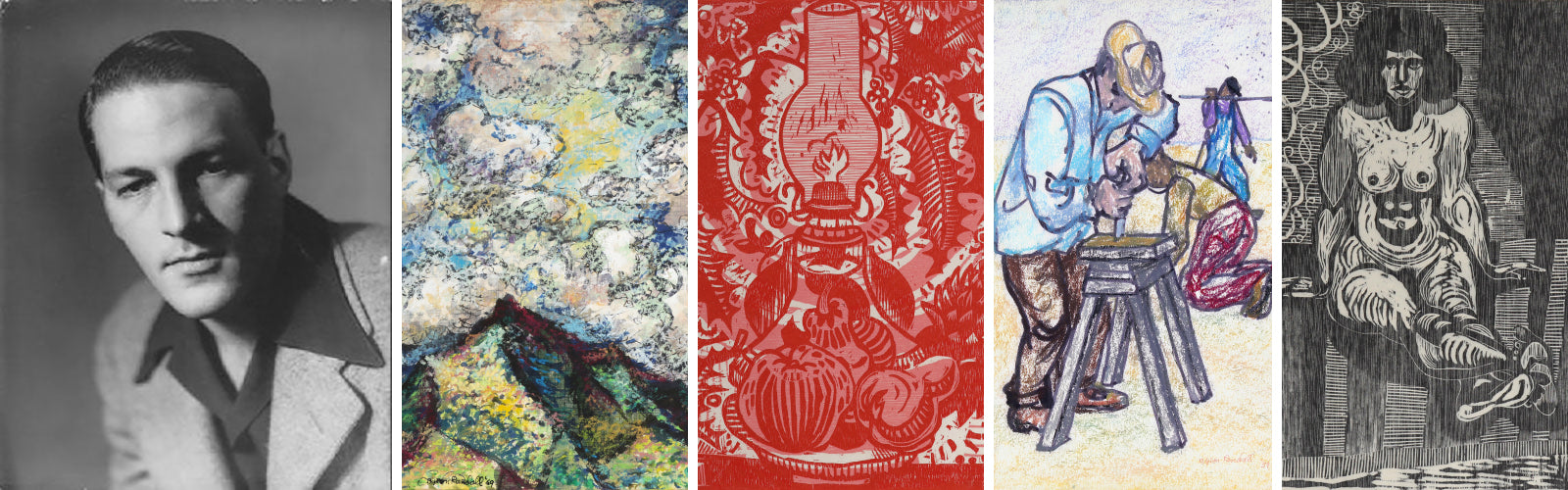
 Byron Randall (October 23, 1918 – August 11, 1999) was an American West Coast artist, well known for his expressionist paintings and printmaking. A contemporary of artists Robert ‘Mac’ McChesney, Emmy Lou Packard (his second wife), and Pele deLappe (his final companion), Randall shared their left wing politics while exploring different techniques and styles, including a vivid use of color and line. His work is held in permanent collections of the Phillips Collection, the California Palace of the Legion of Honour, the Montreal Museum of Fine Arts, the Hallie Ford Museum of Art, the Schneider Museum of Art, the Bolinas Art Museum, the Janet Turner Print Collection and Gallery, and the Oakland Museum of California.
Biography The colorful life of Randall began in Tacoma, Washington in 1918. Byron Theodore Randall was later raised in Salem, Oregon, where he worked as a waiter, harvest hand, boxer, and cook for the Marion County jail to finance his art career. Randall trained and subsequently taught at the Salem Art Center, product of the New Deal’s Federal Art Project (The WPA). In 1939, when he was 21 years old, a solo show at the Whyte Gallery in Washington D.C. brought his work to the attention of Newsweek Magazine and launched his professional career. That year, Newsweek called Randall, "the find of the season". That show was followed by others, over the years, in Oregon, New York, San Francisco, Los Angeles, Philadelphia, Chicago, Seattle, Toronto, Montreal, Edinburgh, Leeds, and Inverness, Scotland.
Randall had three wives. His first wife was Helen Nelson, a Canadian sculptor, whom he met at the Salem Art Center while attending her classes in sculpture. She sharpened his commitment to social and trade union activism, and her belief in his talent provided vital support for the fledgling artist. In 1940 they married and moved to Mexico for six months, where they had a child, Gale, and where Randall continued to develop as a painter, inspired by the vibrant landscape and people. During the Second World War years, while Randall served in the Merchant Marines, he continued to paint whenever possible. His experiences in the South Pacific influenced his preference for natural forms and bright colors.
After the war, Randall traveled to Eastern Europe, as arts correspondent for a Canadian news agency, where he witnessed and painted the post-war devastation of Yugoslavia and Poland. Randall and Helen settled in the North Beach area of San Francisco where they had a second child, Jonathan, in 1948. Five years later they left the United States for Canada, to escape McCarthyite anti-Communism. In 1956 Helen was killed by a car. Randall and his children returned to San Francisco in 1958, at the beginning of what was to be a literary and artistic renaissance in North Beach. Randall rented a studio and living quarters in the legendary City Lights Bookstore, owned by Lawrence Ferlinghetti.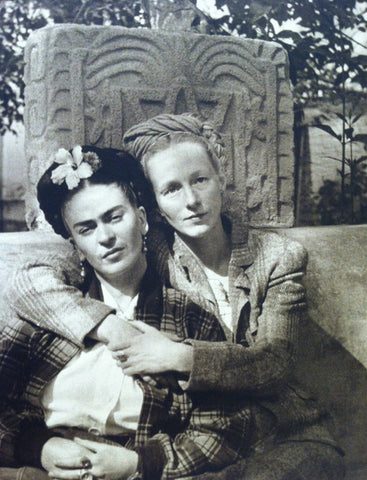
Byron Randall's Second Wife, Emmy Lou Packard (pictured) with Frida Kahlo. Packard was Assistant to Muralist Diego Rivera in 1940.
Between 1959 and 1968 Randall and his second wife, Emmy Lou Packard, ran a Guest House and Art Gallery in Mendocino, California. They were political and environmental activists, involved in the campaign to protect the area from commercial despoliation and in the creation of the Peace and Freedom Party. In the late 1920s Emmy Lou Packard lived with her family in Mexico City where she became acquainted with Diego Rivera, from whom she received regular art criticism and encouragement. She graduated from University of California, Berkeley and completed courses in fresco and sculpture at the California School of Fine Arts in 1940. That year and the next, Packard worked as a full-time painting assistant to Rivera on his 1,650 square-foot fresco at the World's Fair in San Francisco. During this project, Packard became very close to Rivera and Frida Kahlo and returned to Mexico with them and spent a year living with the couple.
After the end of the marriage between Packard and Randall in 1970, Randall established a guesthouse/art gallery in Tomales, California. He converted a dilapidated chicken coop to become his home and studio. In 1982 he married Eve Wieland, an Austrian wartime emigre. She was his wife until her death from cancer four years later. For the last nine years of his life Randall's partner was Pele deLappe, a graphic artist and friend of some 50 years standing. Randall died in August 1999 at the age of 80.
Career
Randall was an expressionist whose art was strongly responsive to physical environment. Of his paintings he wrote: "the look of them might have been different if I'd grown up anywhere but in Oregon. Brilliant sunlight nursing the green valleys after a long rainy winter . . . there's a powerful bit of environment that would show in a man's work all his life. I've seen that creative communication has a vitality all its own. It's not a refuge from life, but an intensification. It's the practice of humanity. In painting I think the approach that best affirms life is expressionism, and that's why I became and am now an expressionist." A figurative artist, Randall experimented with abstraction in the 1940s, and again in the 1980s. Throughout his career he produced still lifes, portraits, nudes and landscapes, in oil, watercolor, gouache, pastel, and print. He also developed plaster sculpture, and three-dimensional collages on the theme of the sea (a recurrent interest). Randall’s concern for working people, and victims of fascism, is most explicit in art from the 30s through to the 50s, and includes his prints of dispossessed Jews from the ghettoes of Eastern Europe, created from firsthand observation. In the 1960s, Randall highlighted the grotesque pageantry of US militarism, using a visual vocabulary of ghastly females, skulls and skeletons that drew upon the folk traditions of Mexican graphic art. As a contrast he invoked the US’s own iconic imagery of liberty and democracy, embodied in Abraham Lincoln, to whom Randall dedicated a series of oil paintings spanning two decades.
Randall saw the human condition as a dynamic struggle for justice or at times simply the struggle for survival, captured in his lifelong scenes of boxers and wrestlers. Not only human but also planetary survival struggles caught his visual imagination. The threat of nuclear apocalypse prompted a series of huge oils, ‘Doomsday’, in the late 1950s and 1960s. Randall’s late works of the 1980s and 1990s deploy a personal mythology of skulls, Mickey Mouse, Lucifer, and nude articulated dolls to ponder the chaotic horror of consumer culture. ‘Flotsam and Jetsam’, his print series of small lino and wood cuts and related large oils, is the summation of his political critique.
Randall’s art revels in the joyful, sensuous and whimsical aspects of everyday life. It celebrates both male and female nudity, and the hedonistic satisfactions of leisure: surfing, drinking, dancing, lounging, making music. From early on, Randall’s love of tools featured in his work, animating his popular ‘Philo’ oil series of West Coast barns, plows and shovels. Tools and vessels often make their way into his still lifes, as do nudes. Randall saw in manual labor the affirmative potential of a non-industrialized life. This led to unsentimental portraits, in paint and print, of workers, many of which center on Mexican people—hewers of coal and wood, housepainters, diggers, laundry women, stevedores, sellers of bread and chickens. The landscapes of rural Oregon, California, Hawaii, Canada, Mexico and Scotland stimulated Randall, as a watercolorist, to the use of intensely vivid colors and energetic brushstroke. Urban life also claimed his attention, from his early, gloomy cityscapes of New York, and on to 1950s scenes of Montreal and San Francisco.
Organizing, Public Art and Peace Activity The democratic possibilities of printmaking led Randall to Mexico’s graphic arts tradition, embodied in its Taller de Gráfica Popular, associated with artists Leopoldo Mendez, Pablo O'Higgins (a close friend of Randall), Francisco Mora, and Elizabeth Catlett. In 1940, Randall worked at the Taller, and he later became an Associate Member. The Taller inspired Randall to establish both the co-operative Artist’s Guild of San Francisco, in 1945 (serving as President), and the San Francisco Graphic Arts Workshop, in 1947. Participating artists in the Workshop were drawn from the leftist California Labor School and included Victor Arnautoff, Pele deLappe, Louise Gilbert, Lawrence Yamamoto. This leftist art circle also illustrated the 1948 Communist Manifesto in Pictures, commemorating the Manifesto’s centenary with prints by Randall, Giacomo Patri, Robert McChesney, H. Walter Smith, Louise Gilbert, Lou Jackson and Bits Hayden.
Randall’s commitment to public art occasionally took the form of murals: in the late 1940s he painted a mural for the historic Vesuvio’s Café, in San Francisco’s North Beach; in 1957 he painted a mural for the Young Men and Women’s Hebrew Association, in Montreal, and in the 60s he assisted his then wife Emmy Lou Packard in creating the Chavez Student Center bas relief mural at Sproul Plaza, UC Berkeley. Randall joined forces with prominent artists Mark Rothko, Robert Motherwell, Charles Wilbert White, and Frank Stella, in protesting the Vietnam War. Randall’s activism also led him and Packard to the Soviet Union, in 1964, where they had a show of 48 prints in Moscow’s Pushkin Museum, which was featured on Soviet television. And it led him, in the mid 1970s, along with artists Mary Fuller, her husband Robert McChesney, and the Sonoma community, to protest against Christo and Jeanne-Claude’s Californian Running Fence installation.
Permanent Collections Featuring Randall's Work:
The National Gallery of Art; the Phillips Collection; the Fine Arts Museums of San Francisco; the San Francisco Museum of Modern Art; Mills College Art Museum; the Crocker Art Museum; the Montreal Museum of Fine Arts; the Jundt Art Museum; the Maryhill Museum of Art; the Museum of Sonoma County; the Fresno Art Museum; the Musée national des beaux-arts du Québec; the Los Angeles Museum of the Holocaust; the Hallie Ford Museum of Art; the Schneider Museum; the Bolinas Art Museum; the UC Irvine Institute and Museum for California Art; the Riverside Art Museum; the Janet Turner Print Collection and Gallery; the Oakland Museum of California; the de Saisset Museum; the Henry Art Gallery (Seattle); the Western Art Gallery (Bellingham); the Davison Art Center; the Museum of Northwest Art; and the Randall Children's Hospital at Legacy Emanuel
Collections Currently Acquiring Randall's Work:
The Jordan Schnitzer Museum of Art, the Art, Design & Architecture Museum, Long Beach Museum of Art, the Minneapolis Institute of Art, and the Smith College Museum of Art
Private Collections:
Anne Baxter, Samuel Lustgarten, Clifford Odets, and Alfred Stern, among others.
 Byron Randall (October 23, 1918 – August 11, 1999) was an American West Coast artist, well known for his expressionist paintings and printmaking. A contemporary of artists Robert ‘Mac’ McChesney, Emmy Lou Packard (his second wife), and Pele deLappe (his final companion), Randall shared their left wing politics while exploring different techniques and styles, including a vivid use of color and line. His work is held in permanent collections of the Phillips Collection, the California Palace of the Legion of Honour, the Montreal Museum of Fine Arts, the Hallie Ford Museum of Art, the Schneider Museum of Art, the Bolinas Art Museum, the Janet Turner Print Collection and Gallery, and the Oakland Museum of California.
 The colorful life of Randall began in Tacoma, Washington in 1918. Byron Theodore Randall was later raised in Salem, Oregon, where he worked as a waiter, harvest hand, boxer, and cook for the Marion County jail to finance his art career. Randall trained and subsequently taught at the Salem Art Center, product of the New Deal’s Federal Art Project (The WPA). In 1939, when he was 21 years old, a solo show at the Whyte Gallery in Washington D.C. brought his work to the attention of Newsweek Magazine and launched his professional career. That year, Newsweek called Randall, "the find of the season". That show was followed by others, over the years, in Oregon, New York, San Francisco, Los Angeles, Philadelphia, Chicago, Seattle, Toronto, Montreal, Edinburgh, Leeds, and Inverness, Scotland.
 In the late 1920s Emmy Lou Packard lived with her family in Mexico City where she became acquainted with Diego Rivera, from whom she received regular art criticism and encouragement. She graduated from University of California, Berkeley and completed courses in fresco and sculpture at the California School of Fine Arts in 1940. That year and the next, Packard worked as a full-time painting assistant to Rivera on his 1,650 square-foot fresco at the World's Fair in San Francisco. During this project, Packard became very close to Rivera and Frida Kahlo and returned to Mexico with them and spent a year living with the couple.
  A figurative artist, Randall experimented with abstraction in the 1940s, and again in the 1980s. Throughout his career he produced still lifes, portraits, nudes and landscapes, in oil, watercolor, gouache, pastel, and print. He also developed plaster sculpture, and three-dimensional collages on the theme of the sea (a recurrent interest). Randall’s concern for working people, and victims of fascism, is most explicit in art from the 30s through to the 50s, and includes his prints of dispossessed Jews from the ghettoes of Eastern Europe, created from firsthand observation. In the 1960s, Randall highlighted the grotesque pageantry of US militarism, using a visual vocabulary of ghastly females, skulls and skeletons that drew upon the folk traditions of Mexican graphic art. As a contrast he invoked the US’s own iconic imagery of liberty and democracy, embodied in Abraham Lincoln, to whom Randall dedicated a series of oil paintings spanning two decades.
  The democratic possibilities of printmaking led Randall to Mexico’s graphic arts tradition, embodied in its Taller de Gráfica Popular, associated with artists Leopoldo Mendez, Pablo O'Higgins (a close friend of Randall), Francisco Mora, and Elizabeth Catlett. In 1940, Randall worked at the Taller, and he later became an Associate Member. The Taller inspired Randall to establish both the co-operative Artist’s Guild of San Francisco, in 1945 (serving as President), and the San Francisco Graphic Arts Workshop, in 1947. Participating artists in the Workshop were drawn from the leftist California Labor School and included Victor Arnautoff, Pele deLappe, Louise Gilbert, Lawrence Yamamoto. This leftist art circle also illustrated the 1948 Communist Manifesto in Pictures, commemorating the Manifesto’s centenary with prints by Randall, Giacomo Patri, Robert McChesney, H. Walter Smith, Louise Gilbert, Lou Jackson and Bits Hayden.


